Small business owners have been running multimillion-dollar companies on a bank balance and a gut feeling. We found the tools they rely on show them their money — but never what to do about it.


Enterprises hire entire credit departments to protect their cash. Wirth’s Co-pilot gives a $3M factory owner the same defense — in everyday language, on their phone.


THE PROBLEM

  • Roughly 10% of B2B invoices are paid late, and 1–3% default entirely. For many small businesses, a single large default is an existential event, not a bookkeeping problem.
  • Owners have no early warning about the financial health of their own customers. One of our personas assumed a top account would renew — while that customer was already in bankruptcy proceedings.
  • The strategies that solve these problems — trade credit insurance, portfolio factoring, credit monitoring, early-payment incentives — already exist. They’re just locked behind enterprise jargon and enterprise headcount: VP Finance, Chief Credit Officer, Controller, A/R Manager, Credit Manager.
  • The small business version of that org chart is the owner, a bookkeeper, and a third-party accountant.


GOALS

  • Design a mobile-first AI co-pilot that connects a business’s banking, payroll, and accounting data into one live picture; surfaces cash-flow and credit risk before it becomes a crisis.
  • Have Co-Pilot translate enterprise-grade financial strategies into plain-language recommendations the owner can understand, trust, and execute in-app.


MY ROLE

  • UI/UX Product leader, Architecture designer, Lead prototyper, and Ai integration specialist.
PROJECT RESULTS

Impact and Outcomes

In moderated testing, owners aged 35–62 completed the connect-and-diagnose flow unaided and correctly explained what a factoring offer would cost them — the comprehension bar this product lives or dies by.

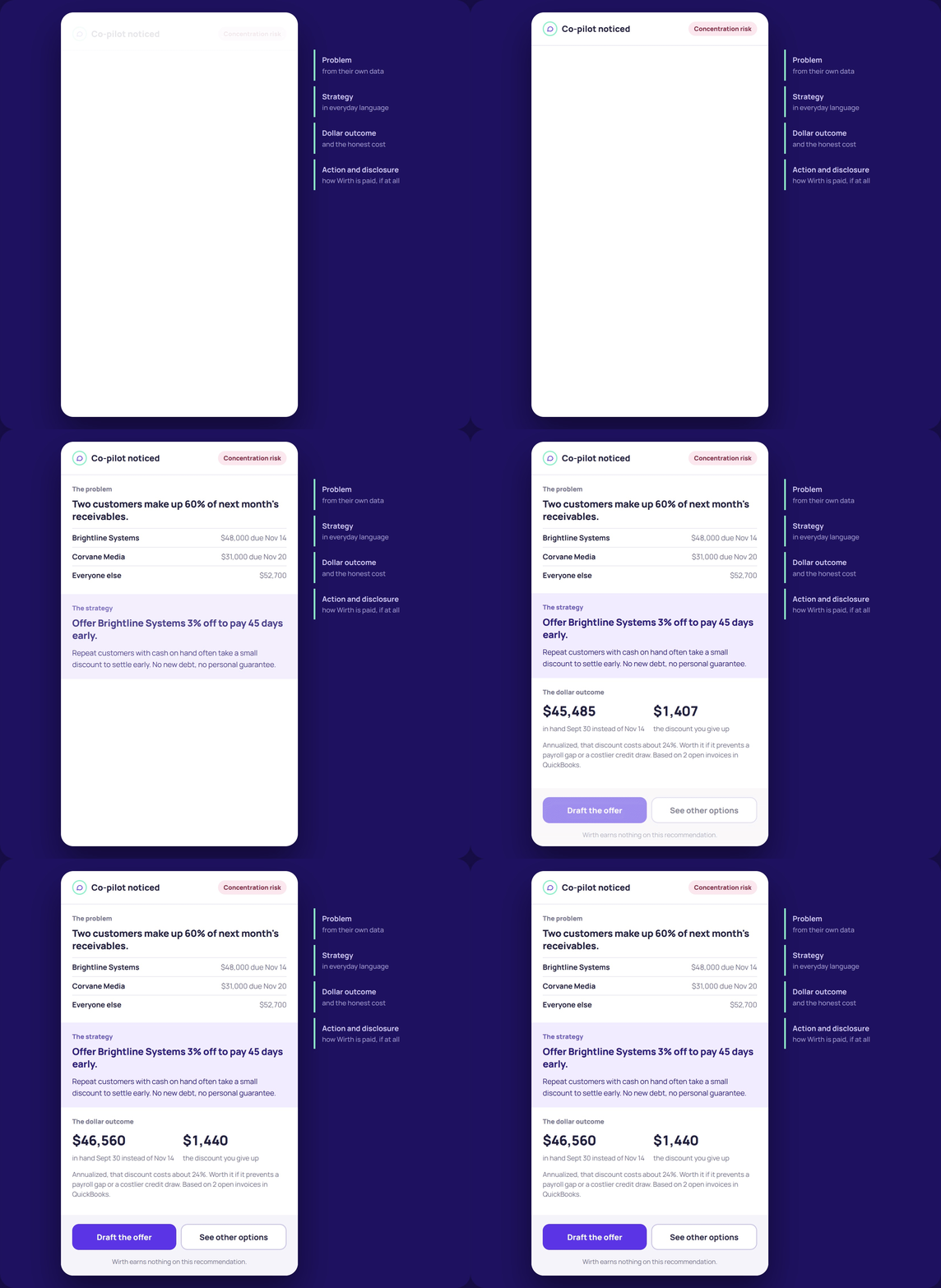
Plain-language finance: every recommendation follows one repeatable pattern — the problem in the owner’s numbers, the strategy in everyday words, and the concrete dollar outcome — so a 60-year-old factory owner and a 35-year-old founder read the same screen with equal confidence.

Trust by design: because Wirth earns origination and referral revenue on the remedies Co-pilot recommends, every suggestion shows its work: the underlying transactions that triggered it, the alternatives (including “do nothing”), and how Wirth is compensated.

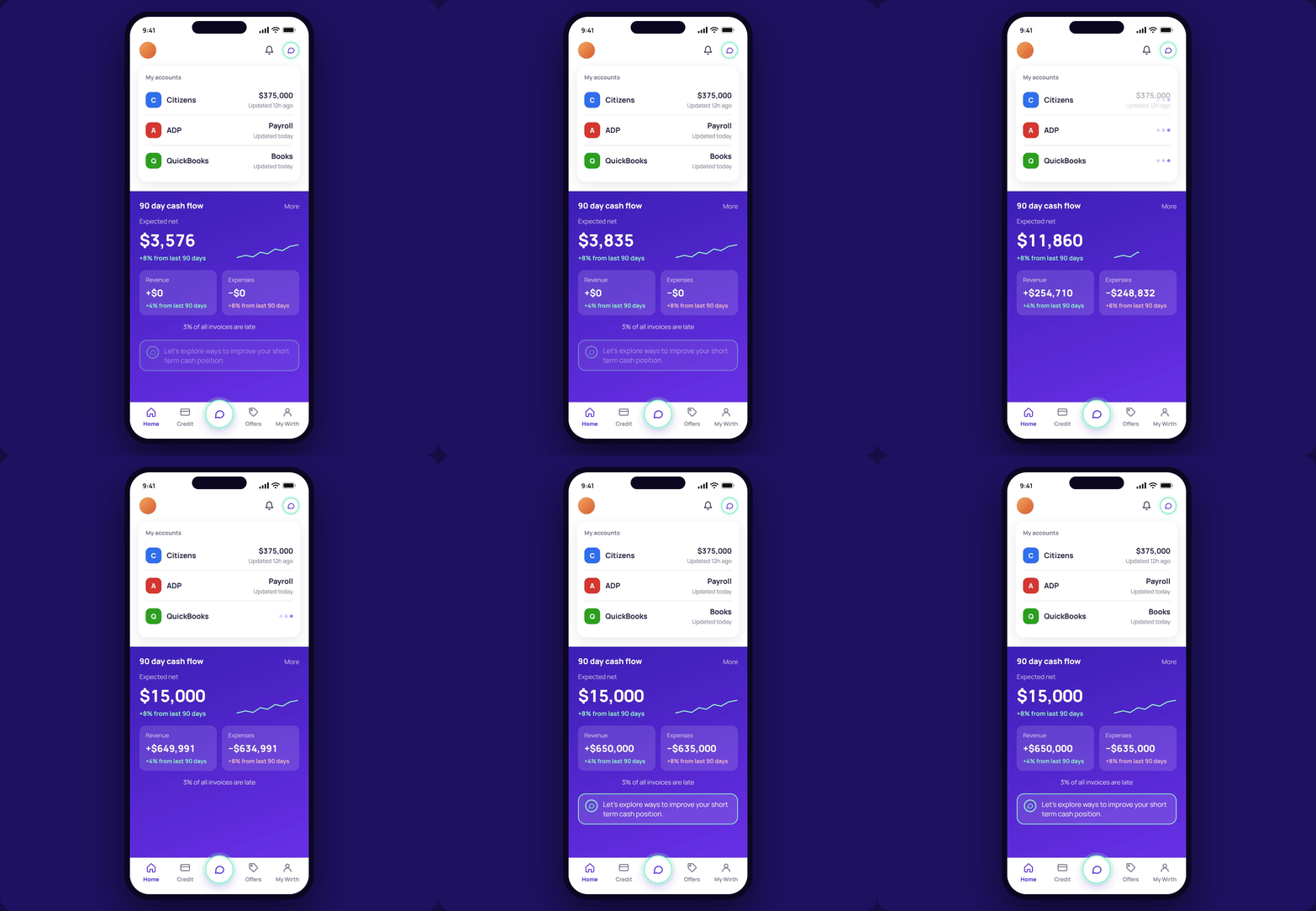
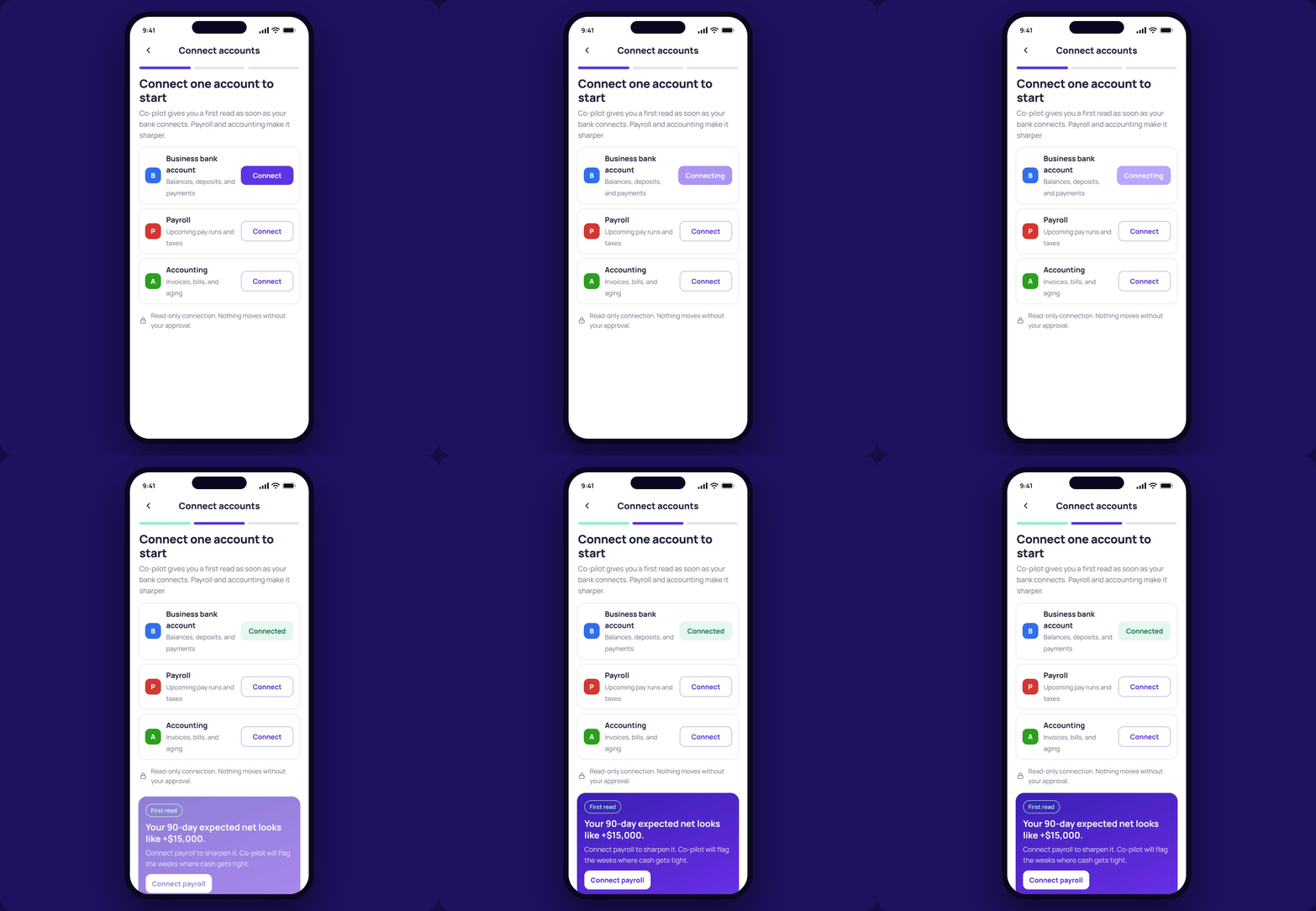
One connected picture: bank, payroll, and accounting feeds (Citizens, ADP, QuickBooks in the initial launch experience) resolve into a single 90-day expected-net view — replacing the daily balance-checking habit with a structured weekly review of cash, receivables, and payables.

  • Membership conversion: 55%
  • Weekly active / retention: 42% and growing
  • Strategy adoption (insurance, factoring, discounts): Multichannel + referral program
To comply with my non-disclosure agreement, I have omitted and obfuscated confidential information in this case study.  The information in this case study is my own and does not necessarily reflect the views of Innovation Refunds & Wirth.
1 of 6 20%
GETTING SMART, FAST

Operating Rhythm

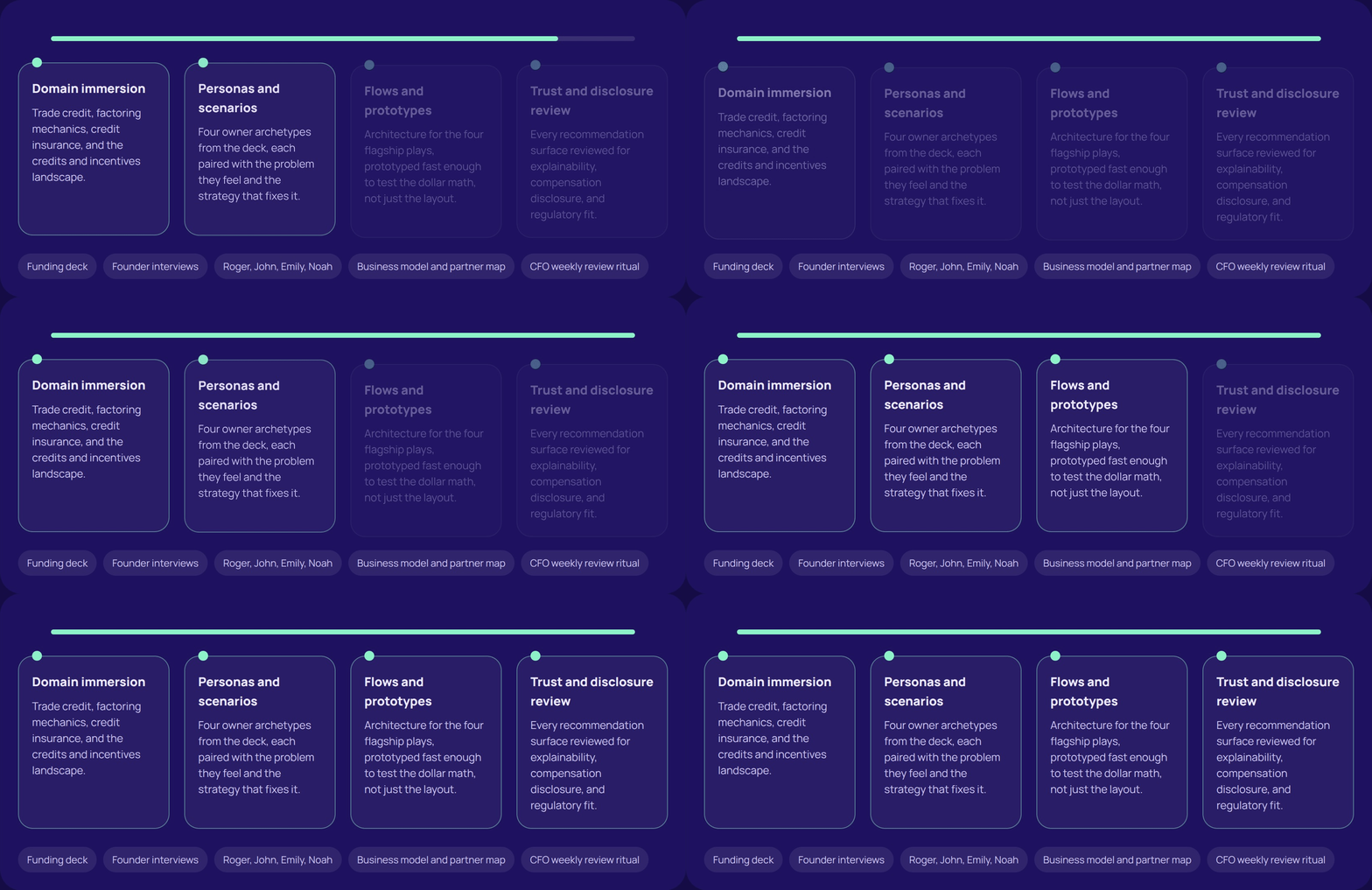
Before touching a screen, we had to earn fluency in a domain most designers never meet: trade credit. The team ran a compressed discovery cycle with the founders to align scope, sequence, and the regulatory guardrails that shape every recommendation surface in a financial product.

  1. Domain immersion — trade credit, factoring mechanics, credit insurance, and the C&I (credits & incentives) landscape.
  2. Persona and scenario definition, pressure-tested against the four owner archetypes below.
  3. Flow architecture and rapid prototyping of the four flagship strategy plays.
  4. Trust, disclosure, and compliance review baked into every recommendation — not bolted on before launch.
2 of 6 35%
THE STATUS QUO

From Bank Balance to Battle Plan

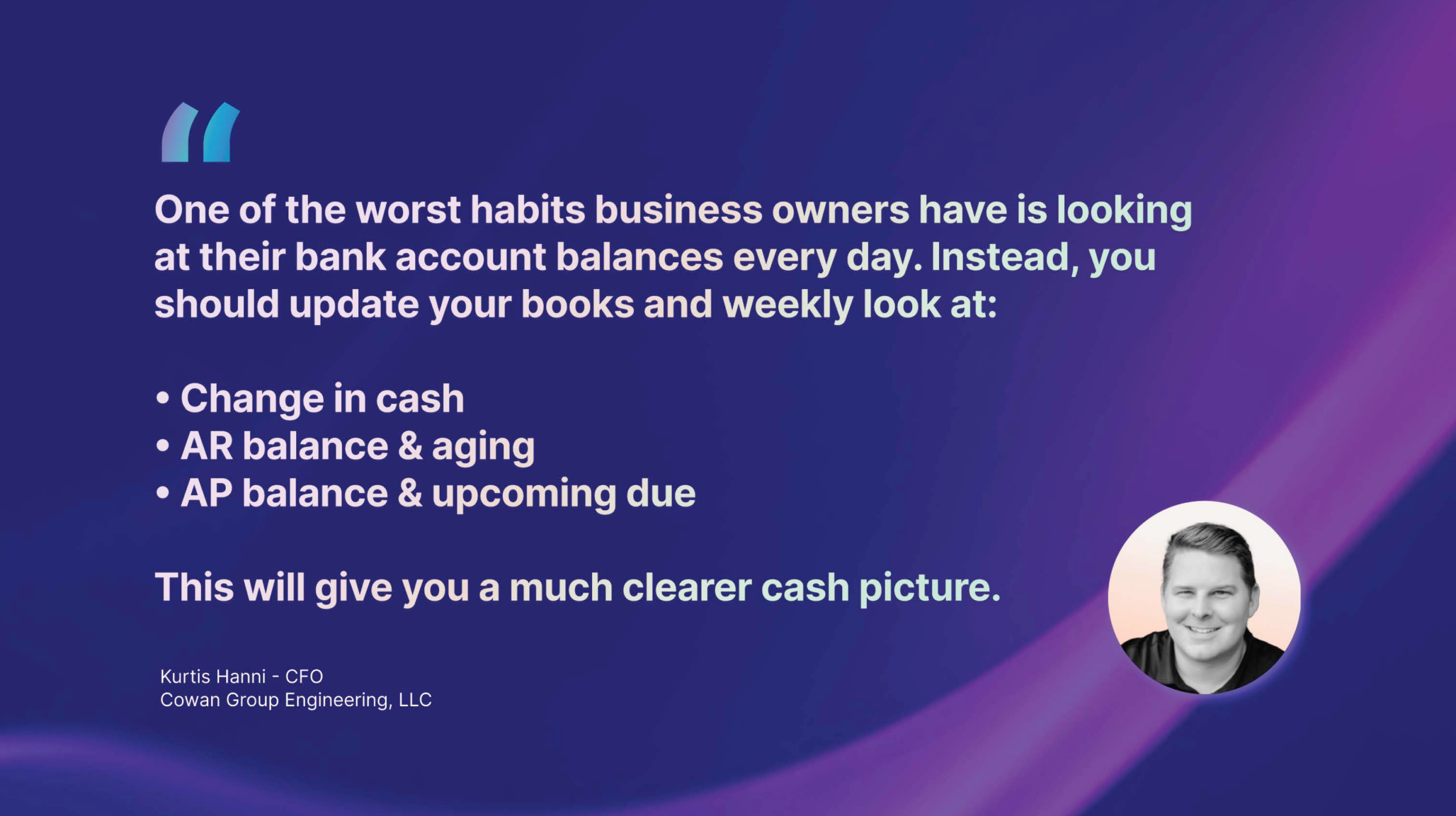
The “before” state isn’t a legacy portal — it’s a habit. As one engineering-firm CFO put it, the worst pattern in small business is checking the bank balance every day and calling it cash management. The redesign target was the ritual he prescribes instead: update the books, then review weekly — change in cash, A/R balance and aging, A/P balance and upcoming dues.

Old: a bank app, a spreadsheet, a QuickBooks tab, and anxiety.

New: one home screen answering three questions at a glance — what’s my expected net over 90 days, what’s late, and what should I do about it?

3 of 6 50%
WHERE WE STAND

Competition

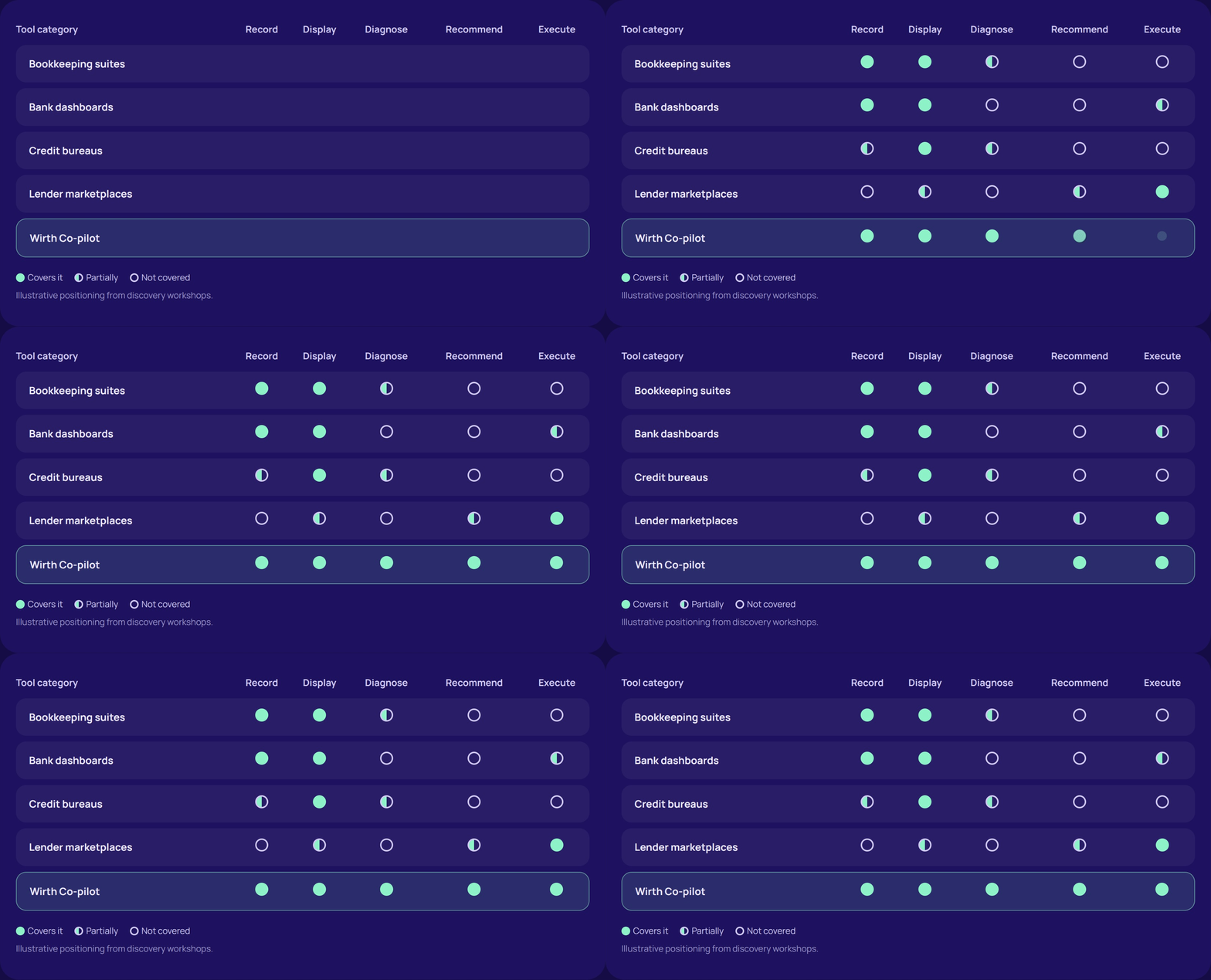
We mapped the landscape owners already use: bookkeeping suites that record the past, bank dashboards that display the present, credit bureaus that sell reports, and lender marketplaces that start at “how much do you want to borrow?”

Each covers one link in the chain. None closes the loop from insight to executed strategy — spotting the concentration risk, explaining the fix, and letting the owner act on it in the same session. That loop is Wirth’s lane, and it dictated the product’s center of gravity: the Co-pilot conversation, not the dashboard.

4 of 6 70%
WHO WE'RE DESIGNING FOR

Our Target Personas

We bucketed our targets by a stricter frame than “SMB.” Every persona runs an invoice-issuing B2B business that extends trade credit — which makes invoices and customers the first-class objects of the interface, not generic transactions. Screening criteria:

  • Owner-operators of B2B businesses in the $1M–$10M revenue range that invoice on terms.
  • No dedicated finance function — the owner plus a bookkeeper and an outside accountant.
  • A deliberate spread of financial sophistication, tech comfort, and age (35–60 in our set).
  • Willingness to connect live data: bank, payroll (e.g., ADP), and accounting (e.g., QuickBooks).

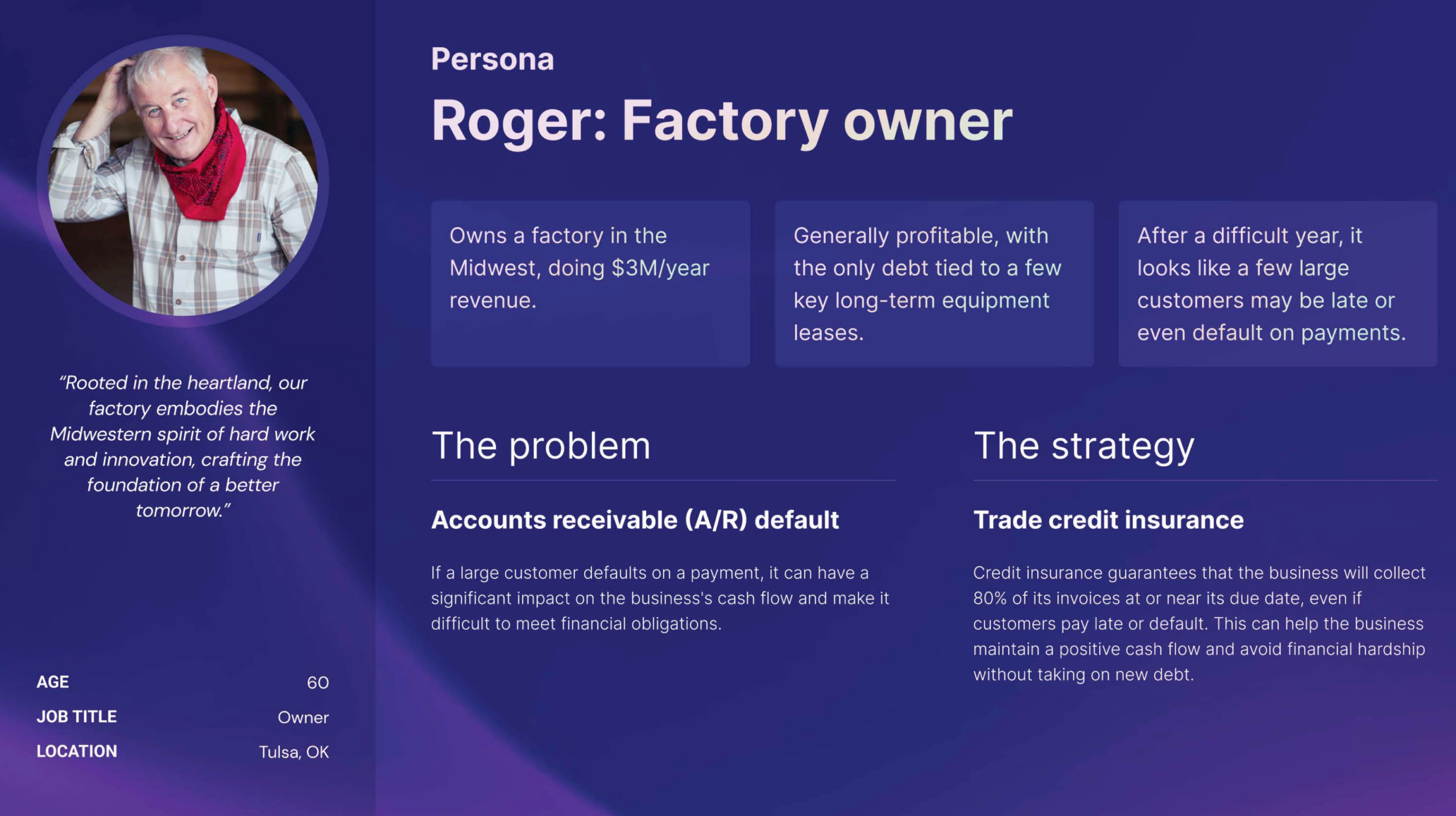
Roger, 60 — factory owner, Tulsa, OK. $3M/year, generally profitable, debt limited to equipment leases. After a hard year, a few large customers look likely to pay late or default. His play: trade credit insurance, guaranteeing collection of ~80% of invoices at or near their due date.

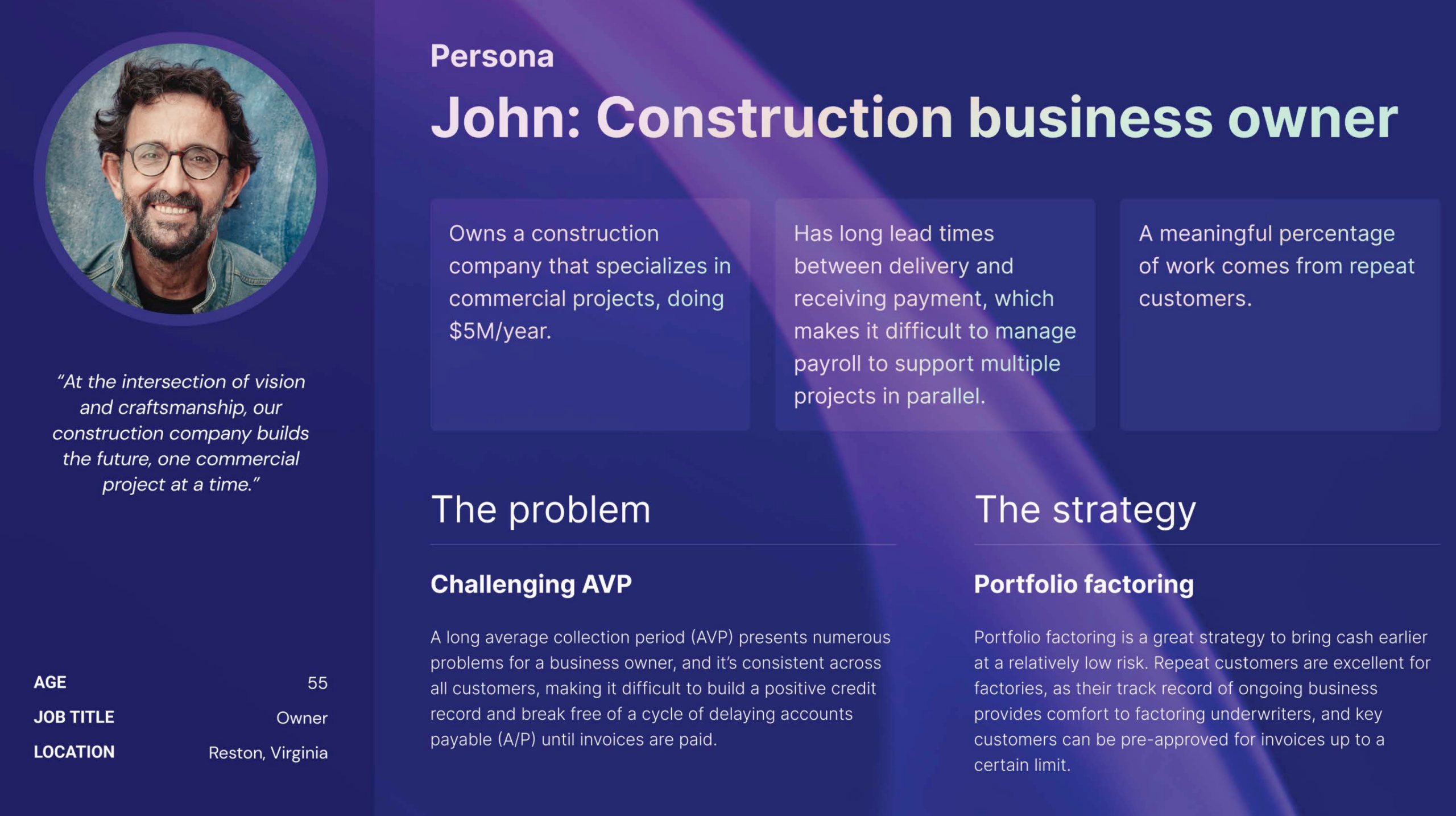
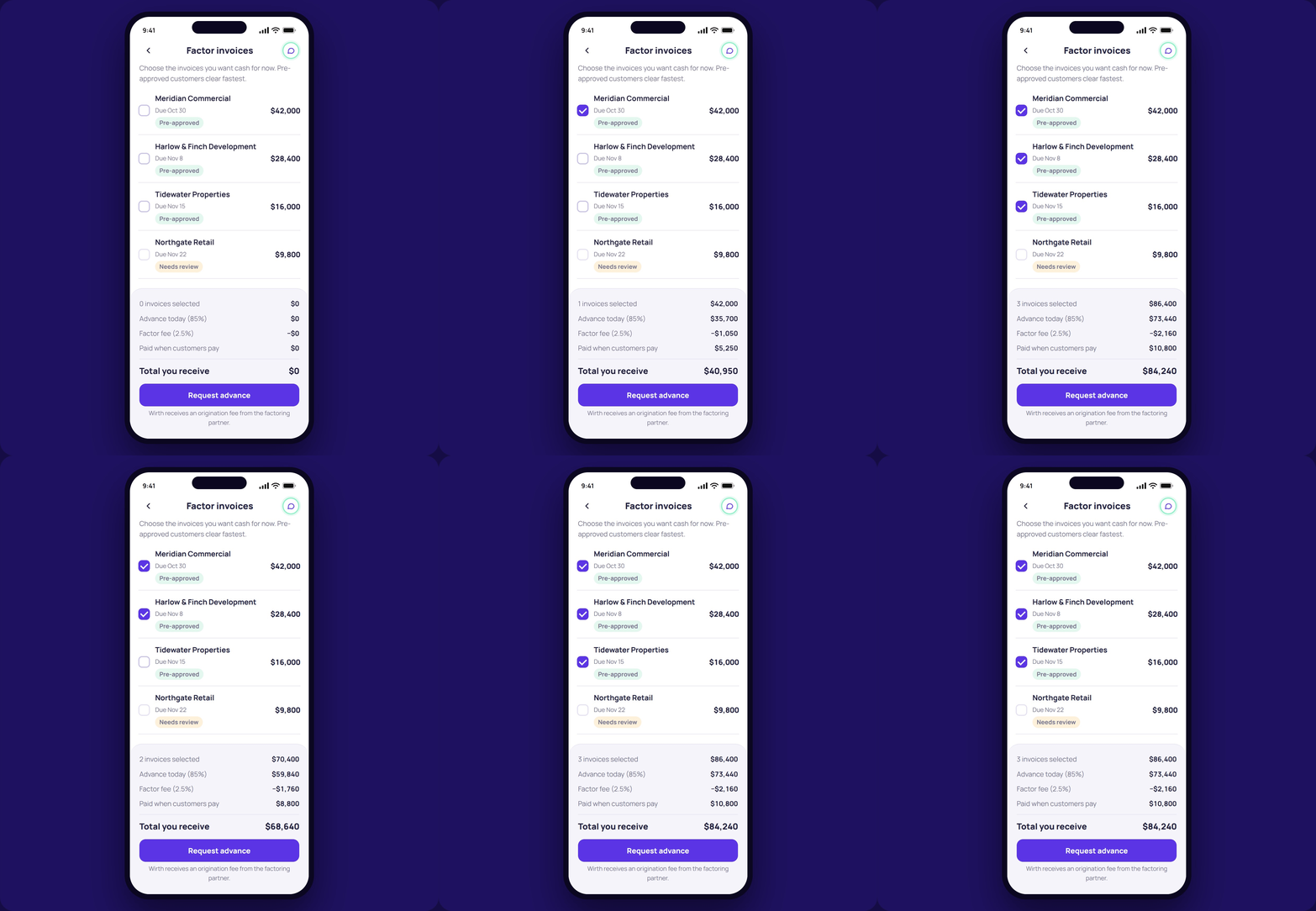
John, 55 — construction business owner, Reston, VA. $5M/year in commercial projects, long gaps between delivery and payment, payroll strained across parallel jobs. His play: portfolio factoring, with repeat customers pre-approved by underwriters up to a set limit.

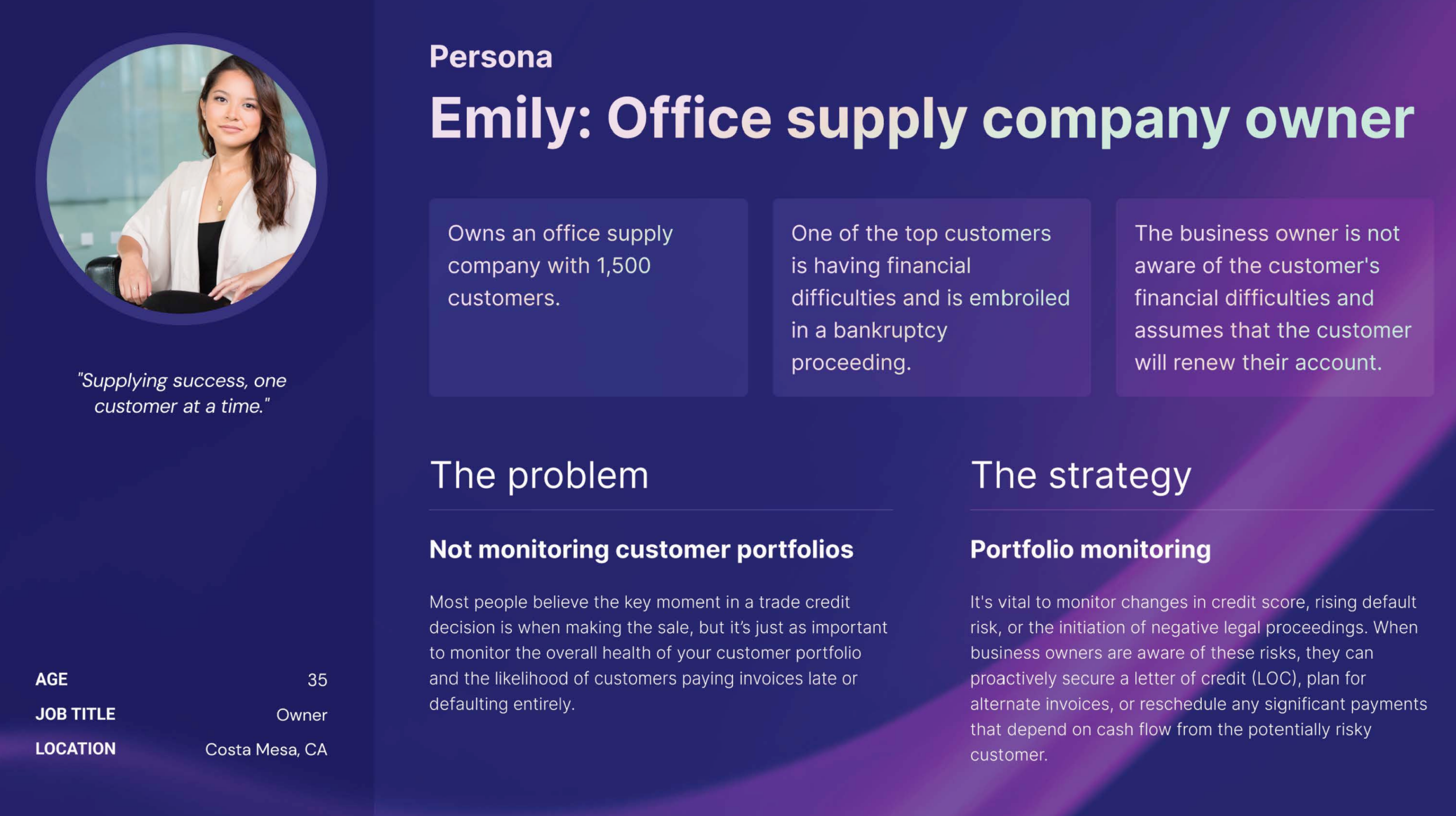
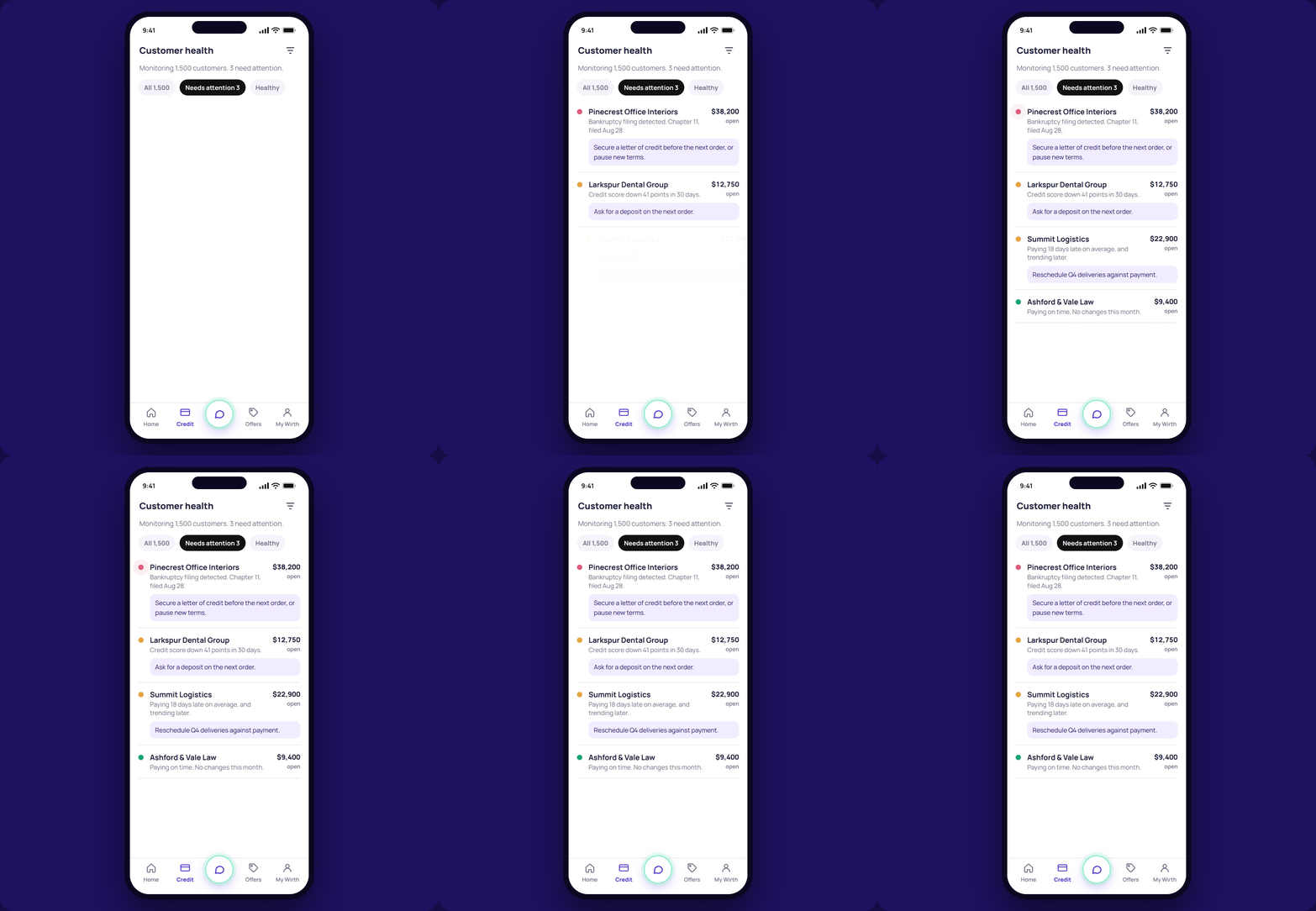
Emily, 35 — office supply company owner, Costa Mesa, CA. 1,500 customers; a top account is in bankruptcy proceedings and she doesn’t know it. Her play: portfolio monitoring — credit-score changes, rising default risk, legal proceedings — early enough to secure a letter of credit or resequence payments.

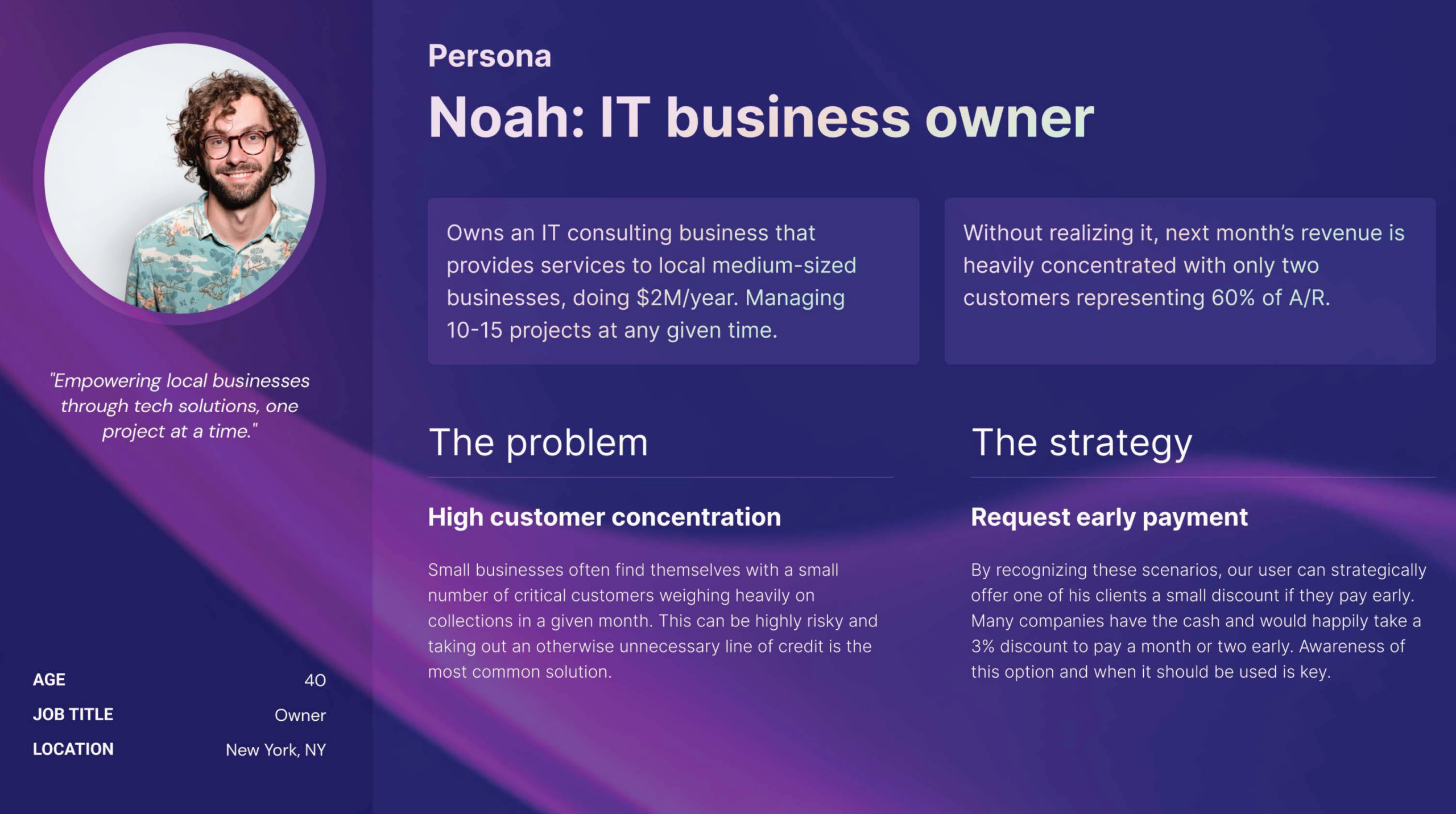
Noah, 40 — IT consulting owner, New York, NY. $2M/year, 10–15 projects at a time; two customers quietly represent 60% of next month’s A/R. His play: a ~3% early-payment discount offered to the right client at the right moment, instead of an unnecessary line of credit.

5 of 6 85%
ENGINEERING PATH

Details, Risks, & Team Growth

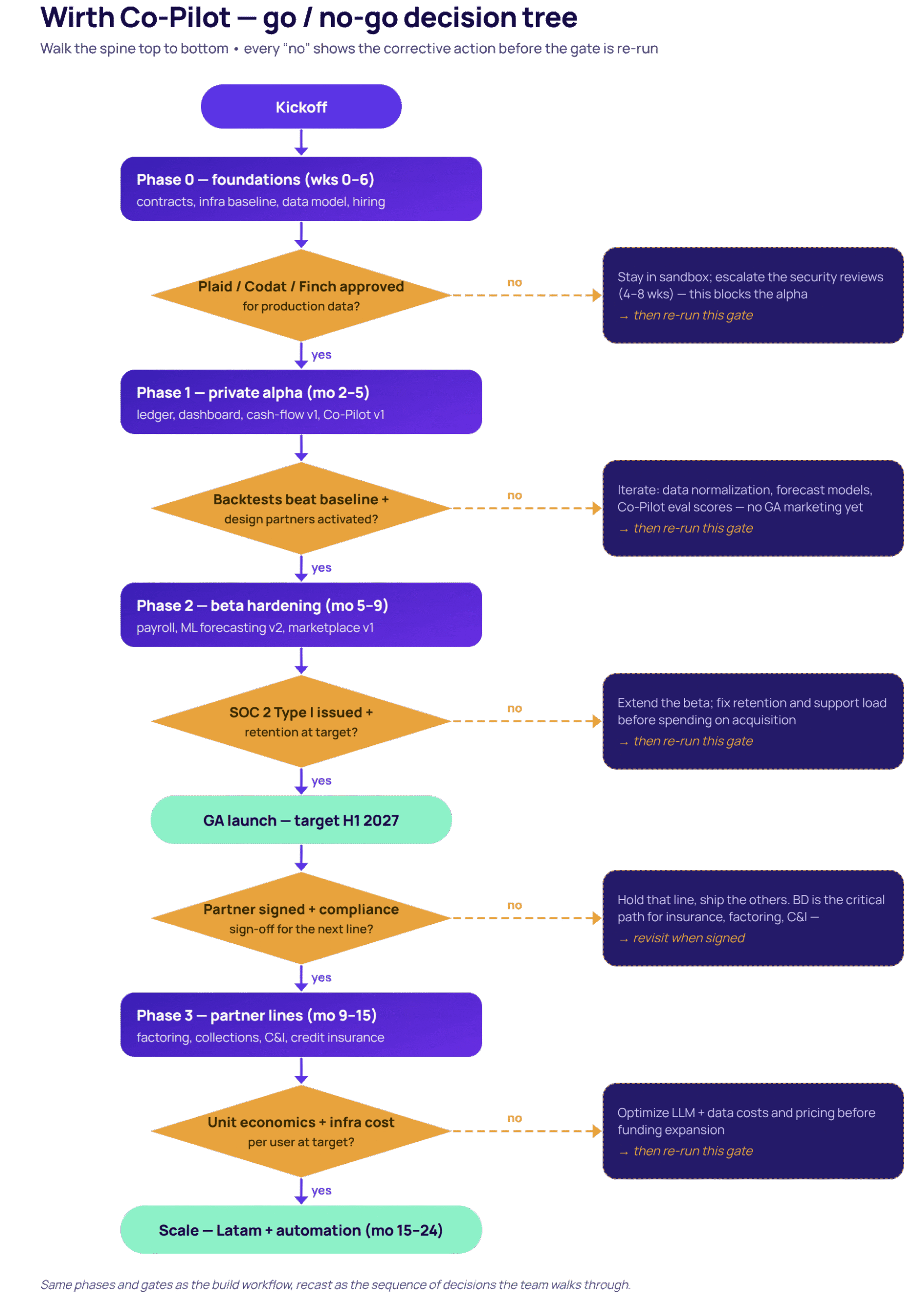
1. Phase detail and exit criteria

Phase Timeframe Key deliverables Exit criteria
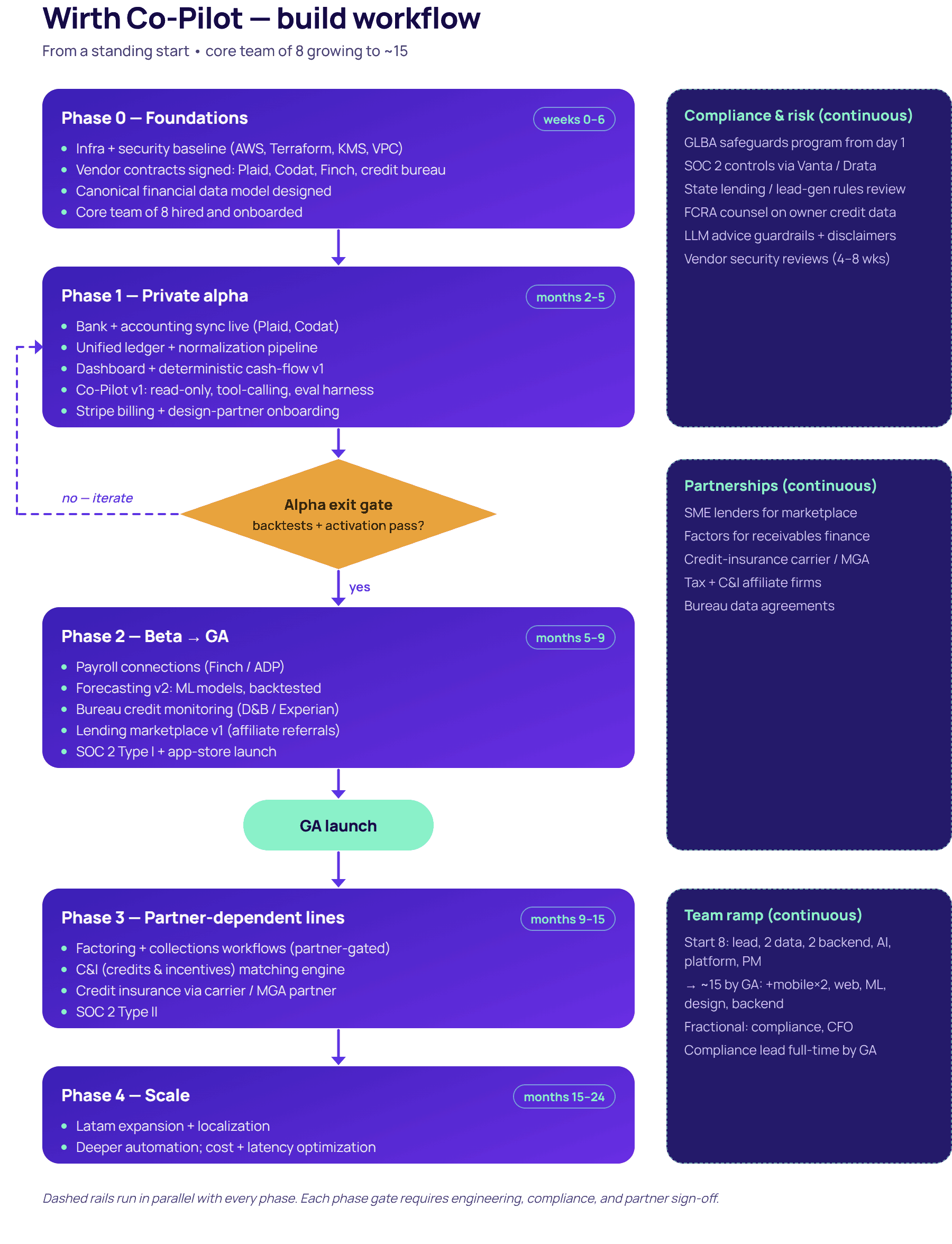
Phase 0 — Foundations Weeks 0–6 Infra + security baseline (AWS, Terraform, KMS); Plaid/Codat/Finch and bureau contracts signed; canonical financial data model designed; core team of 8 hired. Sandbox data flowing end to end; production vendor approvals in motion.
Phase 1 — Private alpha Months 2–5 Bank + accounting sync; unified ledger and normalization pipeline; dashboard with deterministic cash-flow v1; Co-Pilot v1 (read-only, tool-calling, eval harness); Stripe billing and design-partner onboarding. 20–30 design partners active; forecast backtests beat naive baseline; zero fabricated figures across the eval set.
Gate Alpha exit review: forecast accuracy, activation, Co-Pilot eval scores. Fail → iterate on Phase 1; pass → proceed. Engineering + compliance sign-off.
Phase 2 — Beta → GA Months 5–9 Payroll connections (Finch/ADP); ML forecasting v2 with backtesting; bureau credit monitoring (D&B/Experian); lending marketplace v1 as affiliate referrals; SOC 2 Type I; app-store launch. Week-4 retention and activation at target; SOC 2 Type I report issued; support load sustainable. GA target: H1 2027.
Phase 3 — Partner lines Months 9–15 Factoring + collections workflows; C&I (credits & incentives) matching; credit insurance via carrier/MGA partner; SOC 2 Type II. Each line gated on a signed partner plus compliance sign-off — BD is the critical path, not code.
Phase 4 — Scale Months 15–24 Latam expansion and localization; deeper automation; cost and latency optimization. Unit economics at target; infra cost per user trending down.

2. Technology stack summary

Layer Choice Build / buy Notes
Connectivity Plaid (banks), Codat (QuickBooks/Xero), Finch (payroll incl. ADP), D&B/Experian (business credit) Buy Per-connection fees replace months of integration work. Production security reviews take 4–8 weeks — sign contracts in week 1.
Data platform Postgres (ledger), Snowflake + dbt, Dagster, SQS Build on managed The canonical financial model is the moat. Budget real time for normalizing messy SMB ledgers (rules + embedding-based categorization).
Forecasting & risk XGBoost/LightGBM, MLflow, backtesting harness Build Deterministic projections from known invoices/bills/payroll first; ML layers on payment timing and late-pay/default risk.
Co-Pilot (LLM) Claude or GPT API under zero-data-retention; tool-calling; eval harness (Braintrust/promptfoo); PII redaction Buy model, build orchestration LLM narrates deterministic tool results — it never generates financial figures freehand. Prompt-injection defenses on connected data (memos, invoice text are untrusted input).
Applications React Native (mobile), Next.js (web) Build Mobile-first per the deck; one cross-platform codebase.
Backend & infra TypeScript/Node + Python, AWS ECS Fargate, Terraform; Stytch/Auth0 + MFA; Stripe Billing Build on managed Stripe Billing handles the $200/month membership; skip Kafka until scale demands it.
Security & compliance KMS, VPC isolation, audit logging, Vanta/Drata Mixed GLBA safeguards from day one; SOC 2 Type I by GA, Type II in Phase 3.

3. Team plan (~15 by GA, starting core of 8)

Role Count When Mandate
Head of engineering 1 Day 1 Architecture, build-vs-buy calls, vendor strategy, hiring.
Data / integrations engineers 2 Day 1 Plaid/Codat/Finch pipelines, sync reliability, ownership of the canonical model. First hires — everything downstream depends on them.
Backend product engineers 3 Waves 1–2 Ledger APIs, marketplace flows, billing, notifications, ops tooling.
AI engineer 1 Day 1 Co-Pilot orchestration, tool schemas, retrieval, eval harness, guardrails. Someone who has shipped an LLM product.
ML engineer 1 Month 2 Forecasting and risk models, feature pipelines, backtesting framework.
Mobile engineers (React Native) 2 Month 2 iOS/Android app and the polish the mockups promise.
Web engineer 1 Month 3 Next.js product + marketing surfaces; flexes into backend.
Platform / security engineer 1 Day 1 AWS, Terraform, CI/CD; drives SOC 2 controls day to day.
Product manager + designer 2 Day 1 / Mo. 2 Fintech UX specialty; roadmap and partner requirements.
Compliance & risk lead 1 Fractional → FT by GA GLBA, state lending/lead-gen rules, FCRA questions, insurance structure. Backed by outside fintech counsel.
Finance domain expert Fractional Month 2 Authors and reviews the strategy playbooks the Co-Pilot draws from.

4. Key risks and flags

  • “Credit insurance — internal” is not an engineering deliverable. Underwriting requires a carrier/MGA partnership, actuarial work, and state licensing. Treat it as an integration, like the tax and factoring lines.
  • LLM liability: the tool-calling architecture, human-reviewed playbooks, eval gates, and escalation to licensed professionals are the product’s license to exist — not nice-to-haves.
  • Vendor approvals: Plaid/Codat/Finch production access takes 4–8 weeks of security review — it is on the critical path from day one.
6 of 6 100%
MAKING IT REAL

Designing the Four Plays

Each persona’s strategy became a decision-support flow with the same skeleton: trigger → explanation → dollar math → action. A concentration alert fires from Noah’s actual receivables; the screen explains the exposure in plain words; the math shows cash-in-hand date and the effective annualized cost of that 3% discount; the action executes without leaving the app. Roger’s insurance flow expresses coverage and the 0.02% monthly premium against his real covered A/R. John’s factoring flow works at invoice level — advance rate, fees, net proceeds. Emily’s monitoring flow ranks customers by risk and pairs every alert with a suggested next move.

Interface principles carried across all four:

  • Show the why. Every Co-pilot claim taps through to the underlying invoices and transactions.
  • Honest uncertainty. Forecasts render as ranges, never false-precision single numbers.
  • Freshness is a feature. Sync stamps (“Updated 12h ago”) are prominent, and degraded-data states are designed, not improvised — a forecast on a broken feed is worse than none.
  • Everyday language, on demand depth. Inline glossary for factoring, AVP, letters of credit; severity-tiered alerts so a tight quarter reads as guidance, not 2 a.m. anxiety spam.
  • The whole finance triad. Invited, permission-scoped roles for the bookkeeper and accountant — because the person updating the books weekly is often not the owner.
PROJECT RESULTS

Impact and Outcomes

In moderated testing, owners aged 35–62 completed the connect-and-diagnose flow unaided and correctly explained what a factoring offer would cost them — the comprehension bar this product lives or dies by.

Plain-language finance: every recommendation follows one repeatable pattern — the problem in the owner’s numbers, the strategy in everyday words, and the concrete dollar outcome — so a 60-year-old factory owner and a 35-year-old founder read the same screen with equal confidence.

Trust by design: because Wirth earns origination and referral revenue on the remedies Co-pilot recommends, every suggestion shows its work: the underlying transactions that triggered it, the alternatives (including “do nothing”), and how Wirth is compensated.

One connected picture: bank, payroll, and accounting feeds (Citizens, ADP, QuickBooks in the initial launch experience) resolve into a single 90-day expected-net view — replacing the daily balance-checking habit with a structured weekly review of cash, receivables, and payables.

  • Membership conversion: 55%
  • Weekly active / retention: 42% and growing
  • Strategy adoption (insurance, factoring, discounts): Multichannel + referral program
To comply with my non-disclosure agreement, I have omitted and obfuscated confidential information in this case study.  The information in this case study is my own and does not necessarily reflect the views of Innovation Refunds & Wirth.